Last night (January 14), the 18th lecture of Peking University Dishui Lake Lecture (PKU-DSLLH) was successfully held. Qian Zhixi, Boya Chair Professor, Changjiang Scholar, and Director of the Center for Ancient Literary Genres Studies(古代文体研究中心)at Peking University, was invited to deliver the special lecture The Literary Tradition of Agrarian Civilization and Tao Yuanming's Art of Pastoral Poetry at the Dishui Lake Theater.

At the lecture, Prof. Qian first traced the origins and evolution of ancient Chinese pastoral poetry, elucidating how the development of agrarian civilization profoundly influenced the literary tradition of pastoral writing and its deep-rooted impact on Chinese culture. He then comprehensively analyzed Tao Yuanming's devotion to pastoral themes—examining the historical context and motivations behind his poetic creations—and dissected the duality of joy and sorrow in Tao's works, highlighting their allusive beauty and artistic mastery in scene depiction. Finally, he explored Tao's monumental influence on later generations of pastoral poetry, providing insights for Lingang Special Area to inherit China's cultural heritage and cultivate patriotism.

Prof. Qian emphasized that the enduring allure of Tao Yuanming's pastoral realm lies not in romanticizing rural life, but in the profound emotional depth he infused into his poetry. His verses embody steadfast life values, universal human experience, and a profound civilizational backdrop. Tao's poetry pioneered an ancient Chinese pastoral tradition that harmonized agrarian civilization with literati spiritual life. The evolution of landscapes and pastoral themes in Chinese literature is intrinsically linked to the spiritual development of scholar-officials. Philosophically, the scholar-officials' practices of reclusive living in nature and cultivating rural estates marked a paradigm shift—from the natural outlook of heaven-human correspondence toward the establishment of a landscape-nature worldview rooted in Daoist natural philosophy.

During the interactive Q&A session, Prof. Qian shared his insights with the on-site audience based on his own research in response to questions such as "How should we understand Tao Yuanming's poems today and better draw spiritual nourishment from them?", "What are the reasons for the differences between Tao Yuanming's thoughts and style and those of other celebrities in the Wei and Jin Dynasties?", and "What is the distinction between the 'seclusion' of traditional scholar-bureaucrats and the 'lying flat' trend among modern people today?". He believes that returning to the countryside is just a form. Unlike other reclusive literati, Tao Yuanming was simple and down-to-earth. His life path was not merely about returning to the countryside, but more about returning to the soul, returning to the natural state of personality, and returning to the naturalness of life philosophy. Tao Yuanming is a "poet of life" and has been regarded by a group of literati such as Su Dongpo, Huang Tingjian, and Zhu Xi as a "comprehensive and supreme example of self-perfected personality", which constitutes his greatest influence on the history of Chinese literature. The on-site discussion and communication were conducted in a lively atmosphere.


This session of the Lecture Hall specially invited nearly 30 students from Shanghai East School. Addressing both the students—who had primarily encountered Tao Yuanming through textbook excerpts—and the general audience, Prof. Qian shared two deeply influential lines from Tao's poetry: "Though I cannot yet estimate the year's harvest, the work itself brings me much joy" (虽未量岁功,即事多所欣) and "My physical form follows the course of transformation, while my spirit remains ever serene" (行迹凭化往,灵府长独闲). He encouraged everyone to embrace these verses as personal mottos, reminding themselves to embody their wisdom in daily practice.

Wu Xiaohua, Deputy Secretary of the Party Working Committee of Lingang Special Area, attended the event and presented the commemorative lecture plaque. Over 300 participants—including representatives from relevant departments of the Administrative Committee, Peking University Lin-gang International Sci-Tech Innovation Center(PKU-IICSH), and registered citizens—attended on-site. Nearly 3,000 viewer engagements were recorded through live streams on local new media platforms.

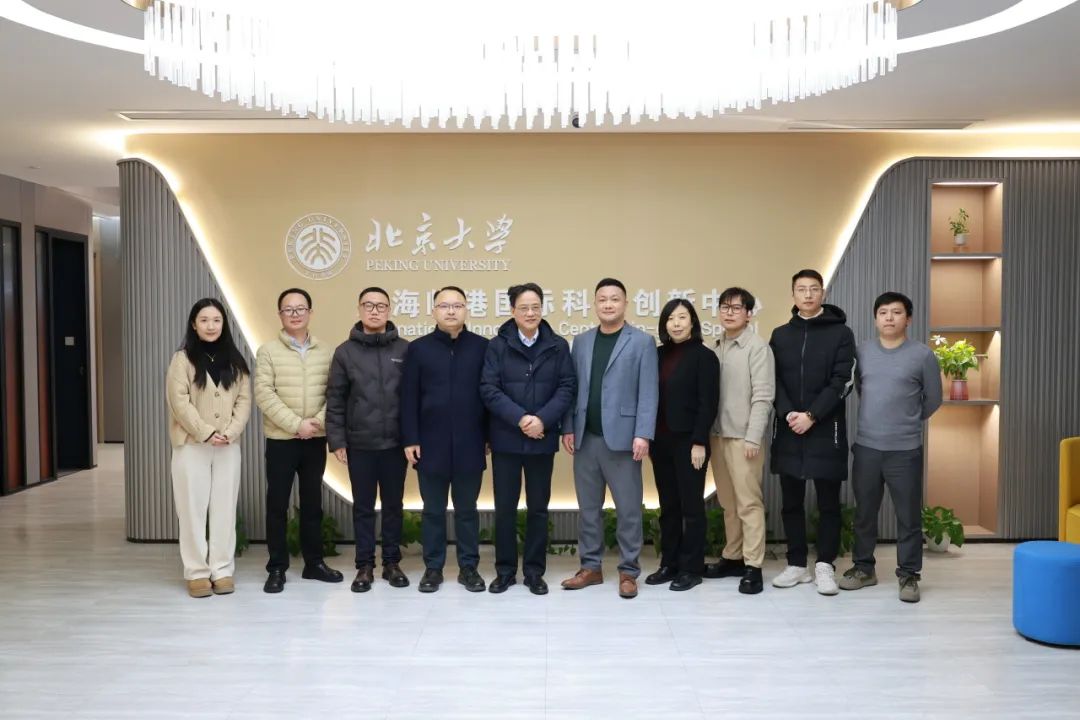
Before the lecture, Prof. Qian conducted an on-site inspection of PKU-IICSH, visited the Party-Mass Service Center and PWA Instrumentation & Service Center for Biomedicine, and offered his kind guidance to the center's development.
Initiated with the support of the China (Shanghai) Pilot Free Trade Zone Lin-gang Speacial Area Administration (hereinafter referred to as Lin-gang Special Area, or LSAA), Peking University Dishui Lake Lecture Hall (PKU-DSLLH) is a collaborative effort involving Peking University International Sci-Tech Innovation Center at Lin-gang Special Area, China (Shanghai) Pilot Free Trade Zone (PKU-IICSH), Peking University Office of Science and Technology Development, and Office of Humanities and Social Science, and enjoying an active participation from Peking University Press, Peking University Alumni Association, and other relevant offices and departments. Leveraging Peking University's profound academic foundation and expert resources in the humanities and social sciences, PKU-DSLLH focuses on key areas including economic development, humanities and arts, and social governance.
Since August 2023, PKU-DSLLH has been hosting monthly lectures featuring renowned professors or expert scholars from Peking University, who provide specialized lectures and engage in in-depth discussions with residents in Lin-gang. This initiative aims to facilitate the concentration of high-quality humanities and social science resources from Peking University in Lingang, effectively enhancing the cultural image and urban competitiveness of the Lin-gang Special Area.